| |
We will not contest that Windows/PCs have continually tried to copy both the Mac interface and its hardware innovations.
In fact, in the very important Federal lawsuit of Apple vs Microsoft a few years ago [35 F.3d 1435 32 USPQ2d 1086 (9th Cir. 1994)], Microsoft did NOT contest Apple’s primary contention that most of the Windows operating system had been copied from the Mac operating system.
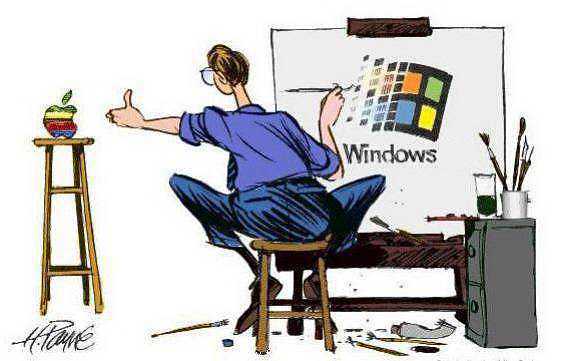
(Since it was indisputable that they had copied as much as they could, Microsoft’s daring arguments were: 1) that the US Government had made a mistake in granting Apple some 100 patents on the Mac operating system, and 2) that Apple had granted Microsoft the right to copy Apple’s operating system. Surprisingly, the judge actually bought these desperate claims... Read a sample legal discussion about this puzzling court decision. Read more of what we have to say about Microsoft.)
[BTW: if you are of the belief that this theft was OK since Apple similarly stole from Xerox, well you are misinformed. Read this to see a more accurate accounting of how Apple had predeveloped most of its features prior to their Xerox encounter, and then PAID Xerox for the rest — to accelerate things. Of course, even if Apple had stolen something, we all know that Two Wrongs Don’t Make A Right.]
Once again a car analogy is appropriate.
Let’s pretend that a non-automotively astute, but financially sensitive, person is shopping for a new car. At a dealership they see both a new $15,000 Escort and a new $16,000 (let’s just say) Mercedes Benz.
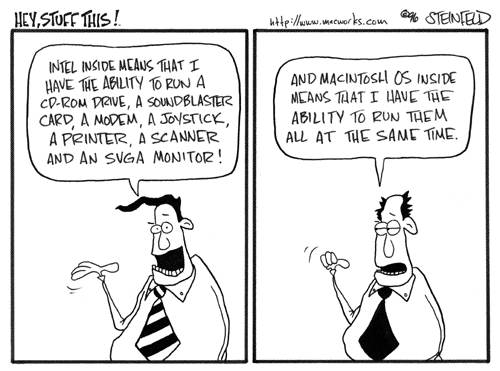
The clever salesperson dude says, “Well, if we can make a deal here, then let’s go for the Escort, as I can save you $1000. And there are two important things you should know: 1) the Escort is the best selling car in the world, and 2) the Escort is essentially the same as the Mercedes.”
Even the non-technical buyer may be a little skeptical about the latter claim, and ask something like “Really? I’ve heard that Mercedes are better cars. Why do you say that they are the same?”
Salesperson: “Glad you asked. Consider these similarities, they both have: four wheels, a spare tire, four cylinder gas engines, stereo radios, automatic transmissions, disk brakes, power windows, yadda, yadda...”
At this point the technically challenged buyer is often swayed by this extensive list of “identical” features. Of course, what the salesperson is very careful to avoid, is the long list of differences.
|
Another perspective would be to compare the “PCs are the same...” assertion to someone proclaiming that “All women are alike.” Sure, there are many similarities, but — believe me — despite being similarly configured, all women ARE NOT ALIKE!
------------------------------
See the excellent "Broader Take on the Mac vs PC debate" (12/03), which highlights BIG differences.
------------------------------
My large ISP’s chief MIS person (a PC/Windows expert) awhile back sent all subscribers this message:
To turn off file sharing in Windows 95/98/ME: 1. Click on the Start menu.
2. Go to Settings, and click on Control Panel.
3. Double-click on the Network icon.
4. From the Network window, click on the bar labeled "File and Print Sharing." A dialog box will appear.
5. Make sure that neither of the check boxes is checked. Click on the OK button.
6. Click on the OK button for the Network Control Panel.
7. You may be prompted to insert your Windows XX CD, and you will need to reboot your computer for any changes to take effect.
To turn off file sharing in a Mac: 1. Go to the Apple Menu.
2. Select Control Panels and File Sharing.
3. Click on the "Stop" (File Sharing) button. (Note: no reboot is necessary.)
-------
I received an email from a foreign language teacher in Michigan, saying “Given the increasing use of MS PowerPoint for our international language classes, we note that the Mac version of this program permits easy input of special characters (German ß, Spanish ¿ and ¡, French ç, diacritical marks (á, à, ä, ê, ñ, etc.), and international punctuation (German, Polish quotation marks: ? . . . .?); however, the Windows version is significantly more difficult to use for creating international presentations. In Windows one is forced through the tedium of selecting the insert symbol menu to access a character chart — a daunting, tiresome, and very slow process. Windows’ Powerpoint lacks the keyboard shortcuts for entering characters found on the Mac.”
-------
Another MIS person wrote: “This is the Windows way. Many things on the Mac that take one step take three in Windows. A lot of things that take two steps on the Mac take five in Windows, etc. Multiply this times the number of things you need to do with your computer every day, and you’ll see how serious this problem is. Again, I’m telling you this from personal experience. I am constantly astounded that intelligent people actually choose to work with the Windows OS every day, and the amount of money they choose to waste by doing so.”
Read this report by a school tech person comparing the time and effort to set up 30 Dell computers (six hours) to 30 iMacs (one hour).
Read this unusually detailed OSOpinion article that goes through many examples of how and why Windows is more complicated to use than the Mac OS... And then there is this.
--------------------------------------
In November 2002, I received an email from an electrical engineer who has used PCs from DOS to Windows 3.11 to NT to 2000, HP UNIX, IBM mainframes, and HP 3000 minis. He expressed frustration as to why more people do not get the clear superiority of Macs over PCs.
“A good example of the differences between these systems came out after the 2000 Presidential election. Before the election most people would have said that the butterfly ballot used in Florida was perfectly fine. You could have talked forever without convincing them that there could be a problem, and that there were better designs. Now everyone knows. To me this is the same as the Mac vs PC situation, where many folks erroneously think that PCs are pretty much the same as Macs. Not! My view is that Windows is not a true GUI but a command-line interface done graphically!”
--------------------------------------
The MIS director at a University of CA campus wrote me "I concur with your assessment of the situation. You should point out the direction Apple has taken with their open-source BSD UNIX core. This is effectively the continuation of the standards-based TCP/IP networking revolution that created the internet, and is going to dramatically alter the software industry. It is a very strong argument in education that since it is open source and standards-based, it is extremely attractive since you are not locked in to a single source (anything that is written for one flavor of UNIX is easily modified for another, e.g. LINUX, FreeBSD, etc)." (Sounds like rather big platform differences.)
---------------------------------
Carefully read consultant Norris and Wong’s VERY detailed study that compared Macs and Windows in regards to many everyday activities. In EVERY CASE, the Macintosh had SIGNIFICANT advantages. (Seems that if things were the same, there wouldn’t be any differences in these common areas...)
An engineer writes: “Most everyone runs out of computer space eventually. PC users cannot just install the OS, drag and drop applications and files from their old drive to their new one — Mac users can. This is because the Mac associates files with the application that they run in, not with a pathname (C:\xxx.xxx) on the drive someplace. In addition, Windows has a registry with all kinds of garbage stored away in it which prevent users from simply copying their old data to their new drive and having it work. The Mac is seamless in this respect.”
Another professional wrote me “... There is no serious color management on PC’s. There is no scripting like Applescript on the PC. You can not automate events between non MS products on PCs and you can’t run scripts over IP networks either. Applescript on Macs is the only reason that USA Today and Wall Street Journal can produce some many daily editions customized for local markets...”
Consider this quote: "Market acceptance notwithstanding, Windows is far, far behind the Macintosh." [Computer Reseller News] (Seems that if things were the same, that wouldn’t be any “far behind” aspect to it. And this is a Windows/PC publication...)
I received an email from the director of technology of a large VA school system. He said that for every 400 Wintel computers he had one tech, while a Mac tech could maintain some 900 Macs. (Seems like some significant underlying differences to me.)
Ok, how about viruses? There is a laughably large difference here says the Wall Street Journal (10/03). And this security based site explains that "because Mac OS X offers superior security, and because Microsoft’s security efforts have not produced better defaults, Windows will continue to be a prime virus target." And then there are RATS. (Seems that if things were the same, there wouldn’t be any such differences, but...)
Consider this article by Stuart Alsop. Stuart writes for Fortune magazine, and is a Windows/PC expert. Even though this article is about an earlier version of Windows, it explains the typical challenges faced by all Windows users - none of which apply to a Mac. Furthermore he states “Microsoft’s operating system is what has led to our loss of control over computing”. (Just think about the profound implications of that!)
And in a more recent article Stuart explains that he now bought a Mac because it just works... “Windows, on the other hand, still doesn’t seem to work. Now, of course, you can turn on a Windows PC and have it operate. But you can’t do so without a guaranteed level of frustration, which will definitely increase the more you use the computer... If your Windows experience is like mine, programs will fail or crash; the machine will start acting funny; tasks won’t get completed; you’ll wait around a lot hoping the machine will work after this reboot.” (Sounds like this experienced professional can see a VERY clear difference!)
Consider this recent email I received: “John: I am a computer technician for Metro Public Schools in Nashville, TN. When I was hired five years ago to fix the PCs in the school system I had never even seen a Macintosh. I quickly learned how to repair Macs. I was shocked at how superior the Mac is over PCs. They are easier to use, troubleshoot, and repair. I wish all people could see Mac quality and performance.” (Another PC person now appreciates that they are not the same!)
Consider this July 2002 eWeek article titled “For Plug-and-Play, I Pick the Apple”. Peter Coffee goes on to explain about “how I learned the hard way about the difference between mere IEEE 1394 compliance and genuine, FireWire-class plug-and-play convenience. There’s also a moral to the story, one that may change your perception of evolution versus revolution in personal computing platforms.” (Just because they SAY they are the same does not mean that they ARE the same!)
Consider this article about a former Mac user who exclusively went to a Windows machine for a few years. Now he really gets it. (And now he REALLY knows they aren’t the same!)
Consider this October 2002 report where PC Magazine chose the iMac as its Editor’s Choice. In a sister article they go on to say that ”With its newest addition, the 17-inch iMac, Apple has done it again — achieved that delicate balance of design, performance, and ease of use that, we stress, is a fundamental part of innovation.” (Did you say PC Magazine???)
Consider this NASA report: which cites a Westinghouse study that showed that engineers doing design work are about twice as productive using a Mac compared to those using a Windows PC. (Again, seems that if things were the same, that productivity would be the same too...)
Consider this July 2002 BBC report. It says, in part: “In the 21st Century, computers have truly gone multimedia. Whereas once we got excited about writing letters with word-processing programs and designing shopping lists on spreadsheets, the fun has long gone from those activities. Now it is all about music, video and photographs. Today even the cheapest computers come with the faster, larger hard drives necessary for storing hours of video or thousands of images. The undisputed leader in the multimedia field is Apple, which has refashioned every one of its machines into a digital hub.” (Seems like those obviously biased people at BBC have found some differences.)
Consider this June 2002 USA Today story, which says a mouthful: “For Mac Users, Life Is Less Complicated.” (Seems like that would be a GOOD thing.)
Consider this analysis: A business Mac user gets $24,000 more work done per year, their computer is down 14% less, and it costs less to support than any other platform: Gartner Group (Seems that if things were the same, then the profitability and the amount of downtime would be the same too...)
Consider the Pfeiffer Report that explains that "on a superficial feature by feature comparison, the Macintosh and Windows NT provide similar functionality. It’s only when one looks below the surface that important differences emerge." The report then goes on to enumerate several Macintosh advantages, like reduced maintenance costs. (Seems that if things were the same, then the maintenance, etc. would be the same too...)
Consider the Evans Research Associates report (PDF), which surveyed 150 people who regularly use both Macintosh computers and Windows/PCs in business, home, and education. Overall, people who use BOTH systems rated the Macintosh computer higher in overall satisfaction, user productivity, creativity, and a wide variety of attributes (ease of setup, ease of troubleshooting, ease of connecting peripherals, etc.). (Seems that if things were the same, then the opinions of dual users would be evenly divided.)
Consider the very exhaustive research done by Dr. Michael J. Johnson, Deputy Superintendent for Instruction and Technology for the Conroe School District, a northern suburb of Houston. He set out to conduct an objective analysis as to which computer platform was better for education users, and this study involved three researchers working for three years with 200 educational technology projects in 14 states. The decisive conclusion of the report was that everything in education that could be done on a Windows/PC computer, could be done cheaper, simpler, and better on a Macintosh. (Doesn’t seem that would be the result if Macs and Windows/PCs were the same.)
Consider this March 2002 LA Times analysis. It says that the typical high-end PC will “include Microsoft’s Windows Media Player and Windows Movie Maker and the MusicMatch Jukebox MP3 program. These programs lack the features and elegance of Apple’s i-ware. Windows Media Player can’t create MP3 tracks, Windows Movie Maker can’t record finished videos to tape, and MusicMatch Jukebox has a brain-addling user interface... The iMac and Apple’s software have a design elegance that’s missing from the Windows world.”
The story then continues: “I use both Macs and Windows XP computers daily, and the Mac is less frustrating, less commercially intrusive and more elegant. Quite simply, the Mac is a better computer.” (Seems like pretty clear differences to me...)
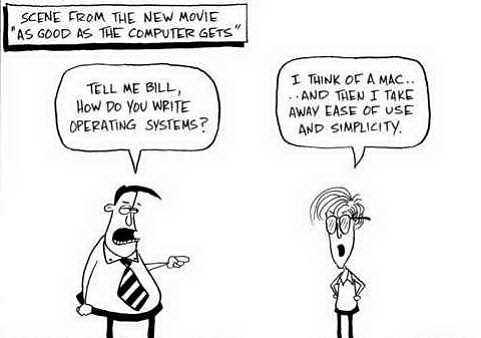
Consider this March 2002 story byNewsFactor Network, where they interviewed several knowledgeable people as to why they preferred a Mac. Some sample quotes: “Rob Enderle, vice president and research fellow at Giga Information Group, told NewsFactor that unlike such companies as Microsoft and IBM, Apple speaks to its user and continues to speak to its user throughout [the Macintosh’s] lifecycle. Most PC vendors gave you the product, and you have to learn to live with it. The Mac was and is distinctive. The PC was the machine you had to have, while the Mac was the one you wanted.”
The article continues: “Alan Promisel, portable PC analyst at research firm IDC, told NewsFactor that people continue to gravitate to the Macintosh because Apple’s industrial designs are hands-down the coolest available on the market. They have cornered the coolness market and set the standard by which other vendors try to achieve coolness.” (Seems like these cross platform experts get it.)
A lawyer’s computer user group’s site says: “A recurring request from Members and Prospective Members is paraphrased as follows: Our managing partner is considering switching from Macs to Windows. Can you tell me where to find information I can use to persuade him not to?
“We do not subscribe to the herd mentality. We have not accepted the commonly held belief that one operating system is better for graphics and publishing while another is better for business applications — because we know the truth: An operating system which is easier to use and more dependable will be more productive in ANY business environment.” And, of course, they were speaking about a Mac, and they enumerate several reasons why the Mac is superior. (If lawyers can figure this out...)
Consider the TechWeb Report that says that the Aberdeen Group, a Boston- based consultancy, has produced numerous case studies about companies migrating to NT and has concluded that they suffer greatly increased costs and user dissatisfaction. (This link is now apparently moved, but it was "http://content.techweb.com/wire/story/TWB19980720S0006". Seems that if things were the same, then the costs and the degree of user satisfaction would be the same too...)
Closely read these to see detailed discussions of why PCs are not the same as Macs, and this, and this, and in this business (where the requirements are for "high quality, 24/7").
--------------------------------------
In this insightful column Mark Collins asserts “Windows uses primarily language to communicate its interface. The Macintosh uses primarily symbols (graphics) to communicate its interface. Well, isn’t one easier than the other? No. However, right-brained people feel more comfortable interfacing with symbols, and left brained people feel more comfortable interfacing with language.”
“Windows is also a lot more structured than Mac OS 9. (Mac OS X’s columns hierarchy may be an attempt to make Windows users feel at home on a Mac.) Mac OS 9 is so flexible in the layout of files and directory structure that it’s nearly formless, except for the form you give it. This frightens structured minded people. They are always thinking of what the correct thing to do is, not thinking in terms of what they want to do. For these left brained people, it’s about procedure, not expression. And that is the difference between Windows and Macintosh... ”
--------------------------------------
This cross-platform user doesn’t have any trouble is seeing the differences. In an article in the Spokesman he says (in part): “Mention Mac and Windows in any polite conversation and it’s guaranteed to become a name-calling, hair-pulling platform war.
“Well, I’m here to end the debate and stop the fight. Simply, the Macintosh is the best computer built today — bar none. I’ve used them both, and based upon personal experience, PCs running Windows XP can’t hold a candle to the elegant user experience provided by a Macintosh running Mac OS 9 or OS X. Macs have style, class, elegance and the best hardware and software available. Sure you can compute using a PC. But why not go in style?...” The article goes on in MUCH more detail.
--------------------------------------
For a brief but informative historical perspective on WHY Wintel PCs are NOT the same as Macs, you will find Alex Patterson’s site most worthwhile. His conclusion is that “The superiority of MAC OS over WINDOWS emanates out of their respective beginnings... It is worth noting that practically ALL the innovation that PC users now take for granted emanated out of Apple (or the Macintosh fraternity), and virtually NONE from Microsoft.”
In the same vein, I received an email from a computer design engineer who said, “The PC is designed from off-the-shelf component parts. In order for it to work, those parts need to be generic (not to mention cheap). The OS for a PC needs to run on those generic parts, so the OS is designed to run on the hardware it is given. That is, the OS supports the hardware.
“The Mac, on the other hand, was designed thus: First, Apple designed how the software ought to work, from a human-engineering standpoint; then they designed the OS that would support that ease of use; then they designed the hardware that would support that OS.
“In short, from the git-go, the Mac is designed to support the people using it; the PC is designed so that the people need to work within the constraints of the hardware.”
--------------------------------------
In an insightful email I received in September of 2002 from Jean-Marc Verniajou, he states (in part) that “The main goal of a graphical human interface is to ease the use of a computer through a visually consistent presentation of data, related information, objects to perform actions and relations between entities of all kinds. Consistency is what makes possible learning what a computer can do through a natural everyday use of all kind of software. The Macintosh graphical human interface is, by nature, by programmer’s habits and by traditional users vigilance, calibrated to ensure consistency. It helps acquiring visual shortcuts naturally. This makes the perception of a situation more ‘a snap’ and the system makes you as comfortable as possible to make a decision at any time.
“The Windows graphical human interface is different. Some objects have been made intentionally globally redundant. The close box of a window being the same as the ‘Cancel’ button most of the time and same as the ‘OK’ button in other cases is a good example. This is an example of what makes consistency in Windows more a free bonus functionality than a guideline users can rely on. Moreover, some programmers don’t use this redundancy twice the same way and a close box sometimes does ‘OK’ in a window where ‘Cancel’ should be the behavior the user thinks is right. (Too bad — try again!) The most puzzling for the user is that they have to remember when the thing happens (and probably to learn it is changed in the next revision of the software).”
--------------------------------------
When cornered by the facts, another witticism I occasionally hear is “Well, what you feel is the better computer just depends on what you’re used to.” I ask you, how come such non-sequitors are so rampant in the computer world, where they would be openly laughed at if used on other everyday matters? (Personally I believe it relates to the fact that most people are technically challenged, and are very cautious to speak up to a perceived “technical expert”.)
Let’s say that you and a friend were discussing what kind of television to buy now. You are suggesting that an HDTV is the best quality option, while this less well-off associate is saying that a black and white TV is perfectly fine. If his argument ends up being “Well, what you feel is the better TV, just depends on what you’re used to”, what would your reaction be to that thinking? Clearly this TV difference has nothing to do with experience: there are discernibly different FACTS. Ditto for computers.
--------------------------------------
You’ve undoubtedly heard of Virtual PC emulation on a Mac, but are you aware of this lower-priced alternative? At MacWindows they show how the power of the Mac makes it an exceptional base to emulate almost anything. And, similarly, this shows you how an enthusiastic Machead got 55 (yes that is FIFTY-FIVE) operating systems to work on his Powerbook! Do not try this on your PC at home...
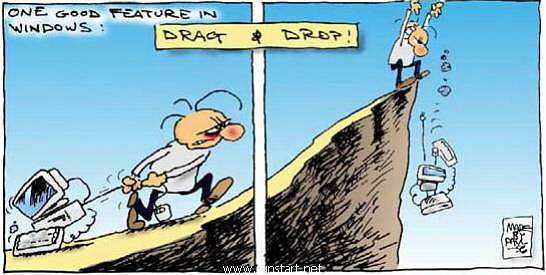
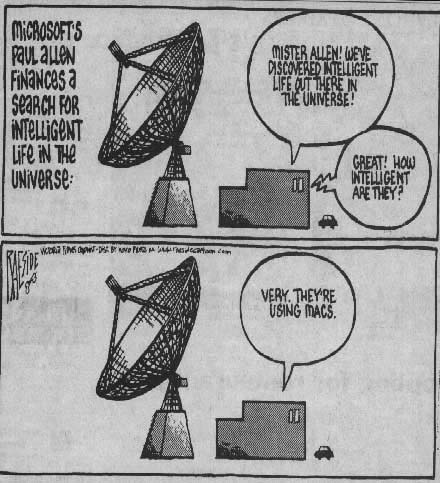
Another reason why Macs are not the same as PCs is that Apple leads the computer industry in innovation. In December of 2003 ComputerWorld said "Apple isn’t a computer company, but a solution company. Apple delivers innovative, elegant and friendly solutions." Then they make a long list of recent innovations like Quicktime Streaming Server, DVD Studio Pro II, The iSight camera and iChat AV software,Mac OS X 10.3 (Panther), X-Serve RAID, etc... And there is Rendezvous, which enables a local network of devices to configure themselves — which PC Magazine calls a "Best Kept Secret."
For examples of exciting hardware see the new iMac and G5. Then check out the fabulous iLife software package introduced in early 2004. No comparable PC package exists... See why Fortune (May 2003) says "Steve Jobs Keeps Rocking My World." This July 2003 USA Today article says that iChat/iSight blows away the competition. MSN Messenger has poorer audio, poorer video, poorer setup, poorer performance... and compared to Apple’s offering is "for the dogs."
http://web.archive.org/web/20060821043402/http://www.ingenuitysoftware.com/ The OSX oparating system has ignited a flurry of creative new third party developments the likes of which have never been seen on ANY platform. Check out Konfabulator, iFile, Fink, Wine, GNUstep, Gentoo, etc. Exciting stuff!
Wired (November 2003) says "Like a comet that passes Earth every few years, Apple Computer consistently comes out of the blue with products that alter the trajectory of the technology business and leave observers rubbing their eyes in amazement. To change an industry once is impressive. To do it as many times as Apple has is phenomenal. For three decades, Apple has blazed a trail for the computer world. The company does the inspired work of figuring out new ways to entice people to buy its machines, only to have other vendors crank out inelegant imitations for the masses. It seems unfair, both to Apple and to the hordes saddled with second-rate gear."
--------------------------------------
Have you heard the one about where some people think that the latest Windows bugs fix (aka Windows XP) is almost as good as the Mac OS X? Just in case you might have, make sure to read our section for the real scoop: OS X vs XP.
--------------------------------------
I don’t know about you, but it sounds to me like there are a LOT of significant differences here...
Oh yes, one more thing. It’s interesting to hear that many of the people promoting PCs say something like “The computer is just a tool.” Well, there certainly is some truth to that. But let’s say that I’m constructing a backyard deck and need to put in several hundred screws — so I buy a battery-operated screwdriver.
Am I better off with: a) a tool that requires me to read twenty pages of assembly and operating directions, and periodically stops working if I don’t follow every instruction just right, or b) a tool that I snap together and start working with immediately (no classes required!), and which performs flawlessly throughout the job?
So for people who are insightful enough to make the "tool" observation, it would seem like they would then also grasp the idea that if there are TWO possible tools for a job, then USE THE BEST ONE. A Mac is very powerful, yet MUCH easier to use — which makes users more productive. The Mac is simply the superior tool: the Swiss Army Knife of computers.
-----------------------------
Conclusion: PCs are NOT “the same” as Macs! Standardizing on Macs will let you get an extremely powerful computer that is less expensive, easier to maintain, and results in more productivity. Download a printable pdf version of this document (rev: 3/06/04). If you have any constructive comments or suggestions about this page,
please email John.
This section’s Haiku
(see the bottom of our Intro page for more explanation):
Yesterday it worked.
Today it is not working.
Windows is like that.
rev: August 1, 2007 — Section #4 — |